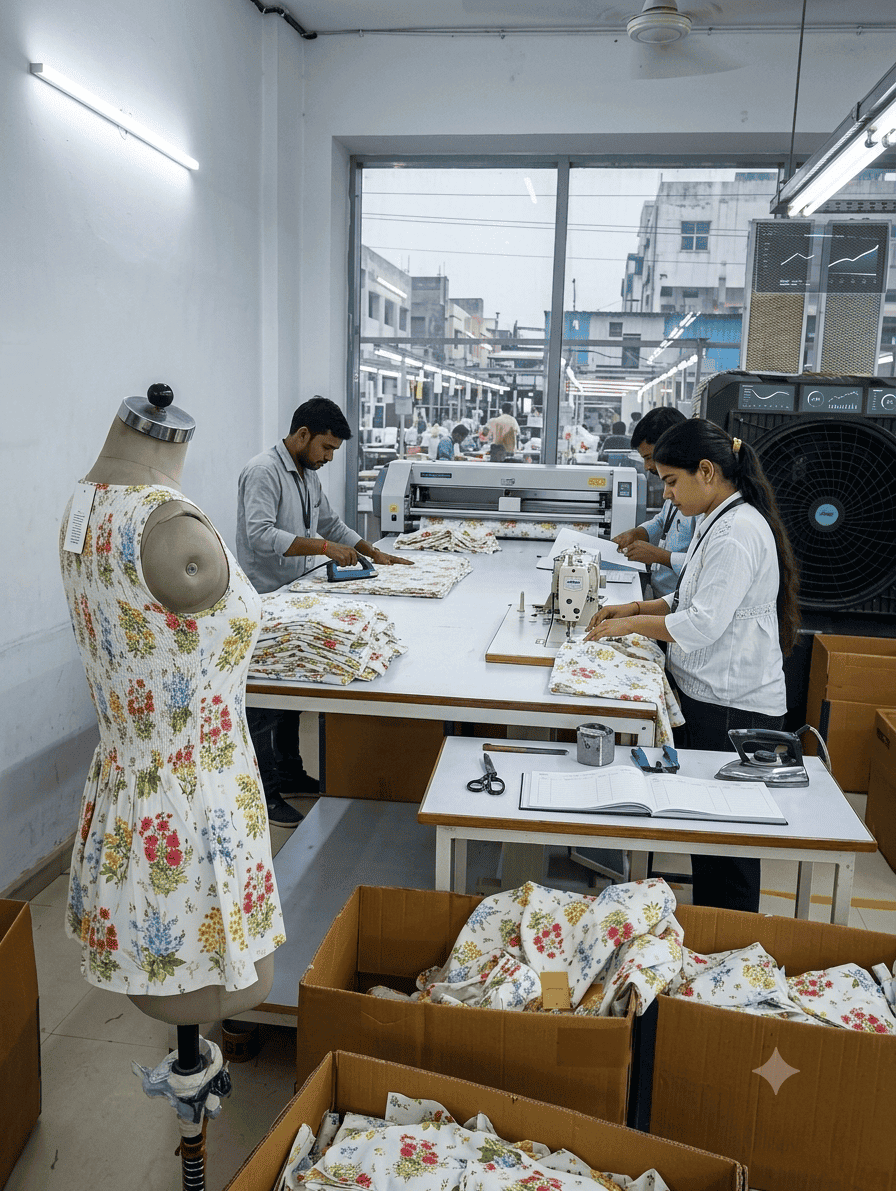
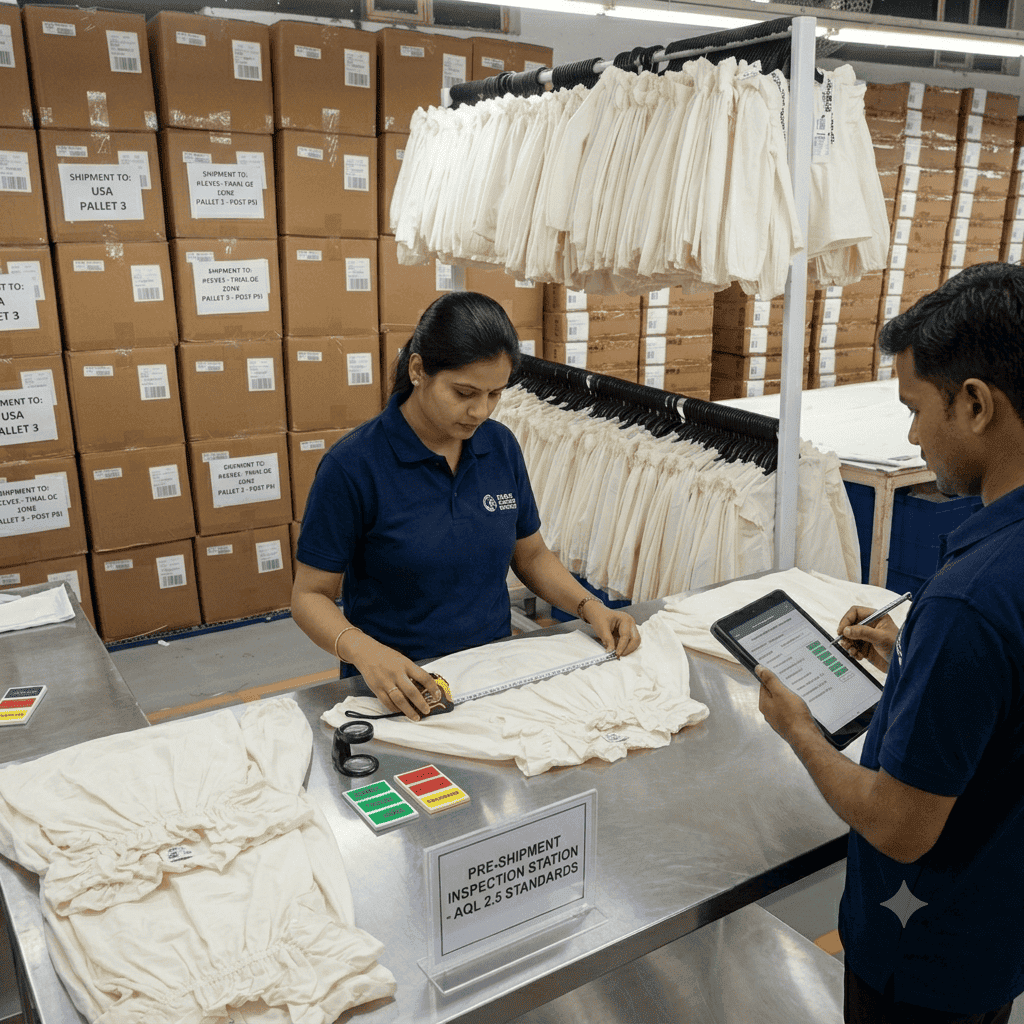
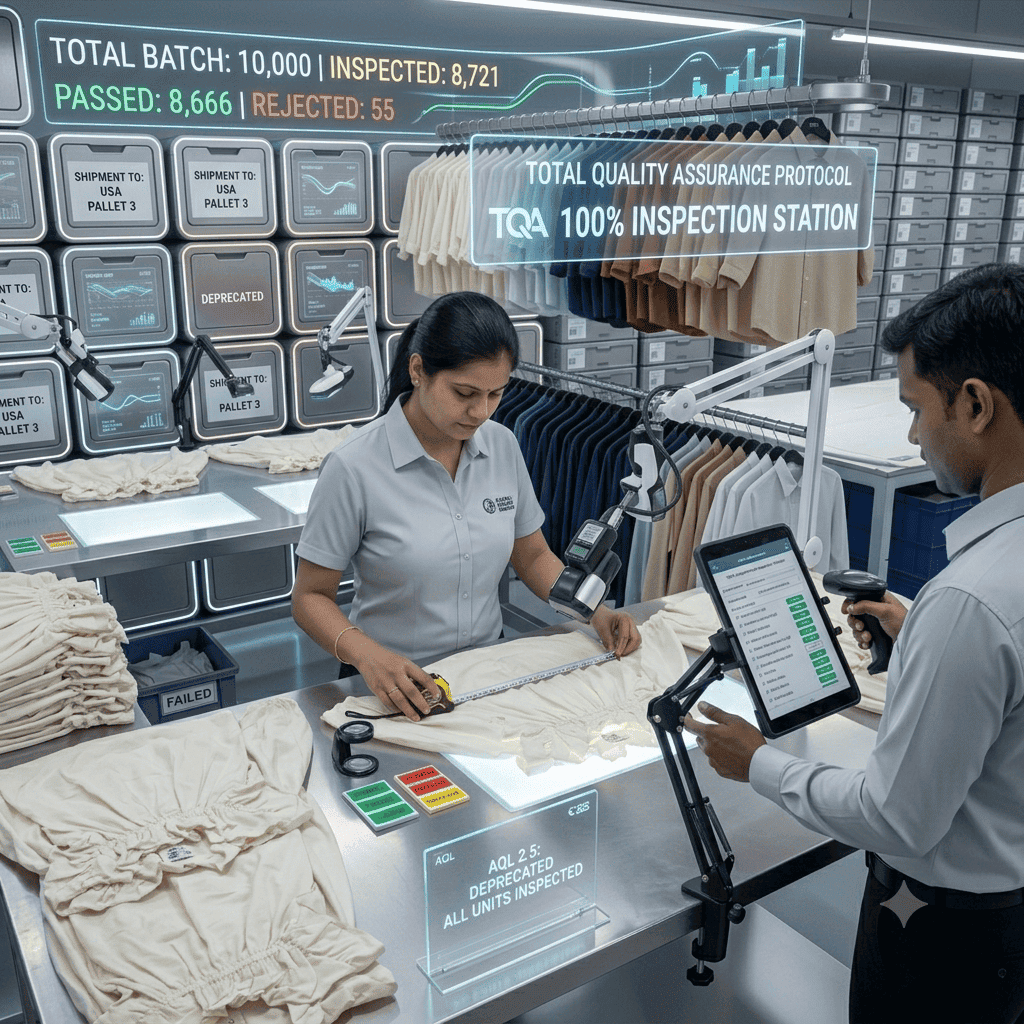
Acceptable Quality Level (AQL) is a sampling protocol that draws a random subset from a production lot and compares defect findings against pre-agreed thresholds. If the sampled pieces carry more defects than the threshold allows, the entire lot is rejected. If they don't, the lot passes.
This replaces opinion with arithmetic. Whether you're reviewing 500 evening dresses or 50,000 basic tees, the same framework applies — documented, repeatable, and defensible to any stakeholder in the supply chain. Our protocol follows the internationally recognized ISO 2859-1 / ANSI Z1.4 acceptance sampling standard.
Every defect we find falls into one of three tiers, each with its own tolerance and consequences.
Unacceptable under any circumstance. A single critical finding typically fails the entire shipment regardless of the AQL table result.
Examples: needles left in garments, sharp metal edges, missing safety or regulatory labels, contamination hazards, suffocation-warning label absent on children's items.
Functionality or appearance is compromised to the point where the customer will return the item or leave a poor review. Standard tolerance is 2.5%.
Examples: open seams, broken zippers, skewed logos, mismatched sizes, holes in fabric, incorrect colour between panels.
Cosmetic or low-impact findings that don't affect usability. Standard tolerance is 4.0%. Acceptable at volume but still worth flagging for improvement.
Examples: uncut threads, slight stitch length variation, minor puckering, faint dust marks that brush off.
It's not a rule written into any standard — it's a buyer-selected default that has proven itself over decades of apparel manufacturing.
A major defect prevents the customer from using the product, or is so visible that they will return it. A broken zipper, a wrong size label, a seam that splits under normal wear, a hole in the fabric — these are the findings that drive returns, chargebacks, and negative reviews.
A 2.5% tolerance accepts that a small fraction of any high-volume production will inevitably carry flaws, while keeping the risk of customer-facing damage low.
Demanding zero-defect production at garment volumes is not economically realistic — suppliers would simply raise their prices or reject orders.
Minor defects do not affect how the product functions. A loose thread, a slightly uneven topstitch, a minor shade shift between two panels — these are visible only under close inspection and do not typically drive returns.
Because the cost of eliminating them entirely is disproportionate to their impact, the standard allows a higher tolerance of 4.0%.
This is a deliberate trade-off that keeps production practical and unit cost reasonable, without exposing the brand to meaningful risk.
A quick look at the inspection process — from random sample draw to AQL verdict and final report delivery.
The default 0 / 2.5 / 4.0 works for most orders — but higher-priced products justify tighter standards, and bulk-value orders sometimes relax them.
Customers paying a premium have little patience for visible flaws. We tighten major tolerance to 1.5% and minor to 2.5% to protect brand equity.
The industry default. Balances quality assurance with production reality across most womenswear, menswear and childrenswear ranges.
For high-volume, low-unit-cost orders, tolerance loosens to keep production economically viable — accepting more variation in exchange for price.
Here's how a real pre-shipment inspection breaks down against the AQL limits.
| Sample Size | AQL 2.5 Major | AQL 4.0 Minor | Verdict |
|---|---|---|---|
| Checked 125 pieces | Maximum allowed: 7 | Maximum allowed: 10 | — |
| Findings recorded | 6 pcs (fabric flaws + skewed logo) | 8 pcs (wrinkles, dust, uncut thread) | PASSED |
| Conclusion: Both defect counts fell within their respective AQL limits. Shipment accepted under G-II / AQL 0/2.5/4.0 sampling standard. Photos and detailed defect descriptions accompany the report. | |||
Every inspection report includes a table exactly like this one — a snapshot of what was checked, what was found, and whether the order passed or failed.
Our checklist is tailored to your garment, but these are the categories that appear on nearly every apparel inspection.
Each stage catches different problems at the point where fixing them is cheapest and least disruptive.
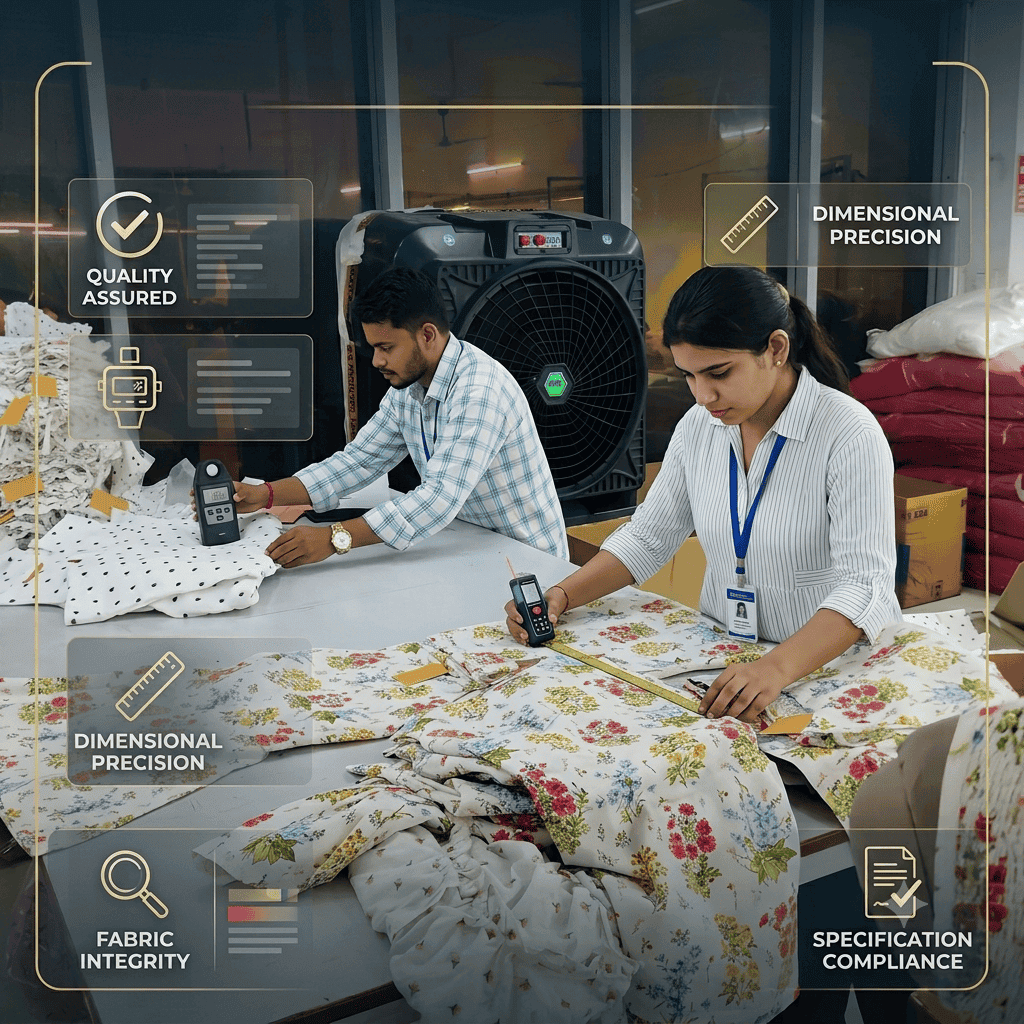
Stage 01
Conducted before any cutting begins. This stage reviews the raw materials, trims, and specifications against your approved standard. Catching a defective fabric lot at this point costs a fraction of discovering the same issue after thousands of units are sewn.
Stage 02
Conducted on the sewing floor while production is running. Rather than a full AQL sample, this is a targeted spot-check designed to catch process issues the moment they appear, so the factory can correct the line before defective units accumulate.
Stage 03
This is where the full AQL sampling table is applied. Once production is complete and goods are packed, this inspection delivers the definitive accept-or-reject decision that most buyers rely on before releasing payment or authorising shipment.
Stage 04
Reserved for orders where zero defects are the expectation — high-value collections, regulatory-sensitive markets, or follow-up to a previous failed inspection. Every single piece is examined individually, and defective units are removed before packing.
From your first message to the final report, here is the entire sequence in plain language.
Tell us the product, order quantity, production location, timeline, and your preferred AQL levels. If you're not sure which AQL levels to use, we'll advise based on your price tier and market.
Same dayWe build a defect checklist tailored to your product — the fabric, the construction techniques, the trims, and any regulatory labeling requirements specific to your market. No generic templates.
1–2 daysAn experienced inspector with relevant category expertise is assigned and scheduled to arrive at the factory on the agreed date. They confirm scope with the factory on arrival and begin sampling.
ScheduledThe inspector draws a random sample, checks each piece against the checklist, measures critical dimensions, examines labels and packaging, and photographs every defect with a reference scale.
Same dayDefect findings are tallied and compared against the AQL limits. The shipment passes or fails based purely on that comparison — not on inspector discretion. The verdict is unambiguous.
Same dayYou receive a full report with the AQL table result, defect categories, all photos, packing and labeling findings, and a clear pass/fail verdict — usually within 24 hours of on-site completion.
Within 24 hoursIndependent, experienced, and specialized — here's what that means in practice.
We have no commercial interest in the factory. Our only loyalty is to the buyer who appointed us.
Decades of combined experience in textiles, apparel construction, and quality assurance across multiple categories.
Every defect we report is backed by clear photographic evidence, so you see exactly what we saw — no ambiguity.
Reports are delivered within 24 hours of on-site inspection, so decisions can be made without delays.
Deep expertise in GOTS, OEKO-TEX, GRS, and BCI compliance — where labeling and material rules are strict.
Every checklist is built around your specific product, not adapted from a generic apparel template.
Findings written so a buyer, merchandiser, or factory manager can all act on them immediately.
Product designs, supplier identities, and commercial terms are treated as confidential, always.
Standard deliverables with every inspection — no hidden extras, no separate line items.
Structured report with AQL results, defect categories, and a clear pass/fail conclusion.
Images of every reported defect and of product checkpoints across the inspected sample.
Defect counts against allowed limits, with the accept or reject decision fully documented.
Verification that care, origin, content, and compliance labels meet your market's requirements.
Carton count, dimensions, shipping marks, polybag condition, and hangtag verification.
Practical suggestions to fix identified issues and prevent recurrence on future orders.
Everything buyers typically ask before booking their first inspection.
AQL sampling reviews a random subset of the total order and uses statistical thresholds to draw conclusions about the whole shipment. 100% inspection reviews every single piece individually. AQL is faster and more affordable; 100% is more thorough but costlier and slower. Most buyers use AQL for standard orders and 100% only when the risk justifies it.
The buyer defines AQL levels and typically writes them into the purchase order. The default for garments is Critical 0 / Major 2.5 / Minor 4.0, though higher-tier products often tighten this and bulk-value orders may loosen it. The standard does not mandate specific numbers for apparel; the numbers are whatever you and your supplier agree on.
On-site inspections typically take one working day for orders up to 10,000 pieces. Larger volumes or complex construction may require two or three days. Reporting is delivered within 24 hours of the on-site completion.
Yes. We specialise in organic textile inspection and have deep expertise with GOTS, OEKO-TEX, GRS, and BCI certification requirements. This matters because organic certification places additional compliance obligations on labelling, dyes, and packaging that generic inspectors often miss.
You receive the full report with photographic evidence of every reported defect. We then work with you and the factory to develop a corrective action plan — rework, replacement, or re-inspection after corrections. In most cases, the supplier fixes the issues before a second inspection is scheduled.
We inspect at the production facility, warehouse, or any location where goods are staged. Most pre-shipment inspections happen at the factory before cartons are loaded, but arrangements can be made for warehouse or consolidation-point inspections.
We build every checklist around the specific product. If you have particular concerns — an unusual print technique, a unique trim, a delicate fabric, or a challenging construction detail — those concerns shape the checklist. There is no generic template.
Pricing depends on order size, number of man-days, location, and whether it's single-stage or multi-stage. Share your order details through the enquiry form and we'll respond within 24 hours with a specific proposal.
Tell us about your order and the inspection stage you need. Fill in the form and our team will prepare your sample kit for dispatch. Shipping is included worldwide — no minimum order required.